About the Resource
A rare Southern Hemisphere natural organic humate resource.
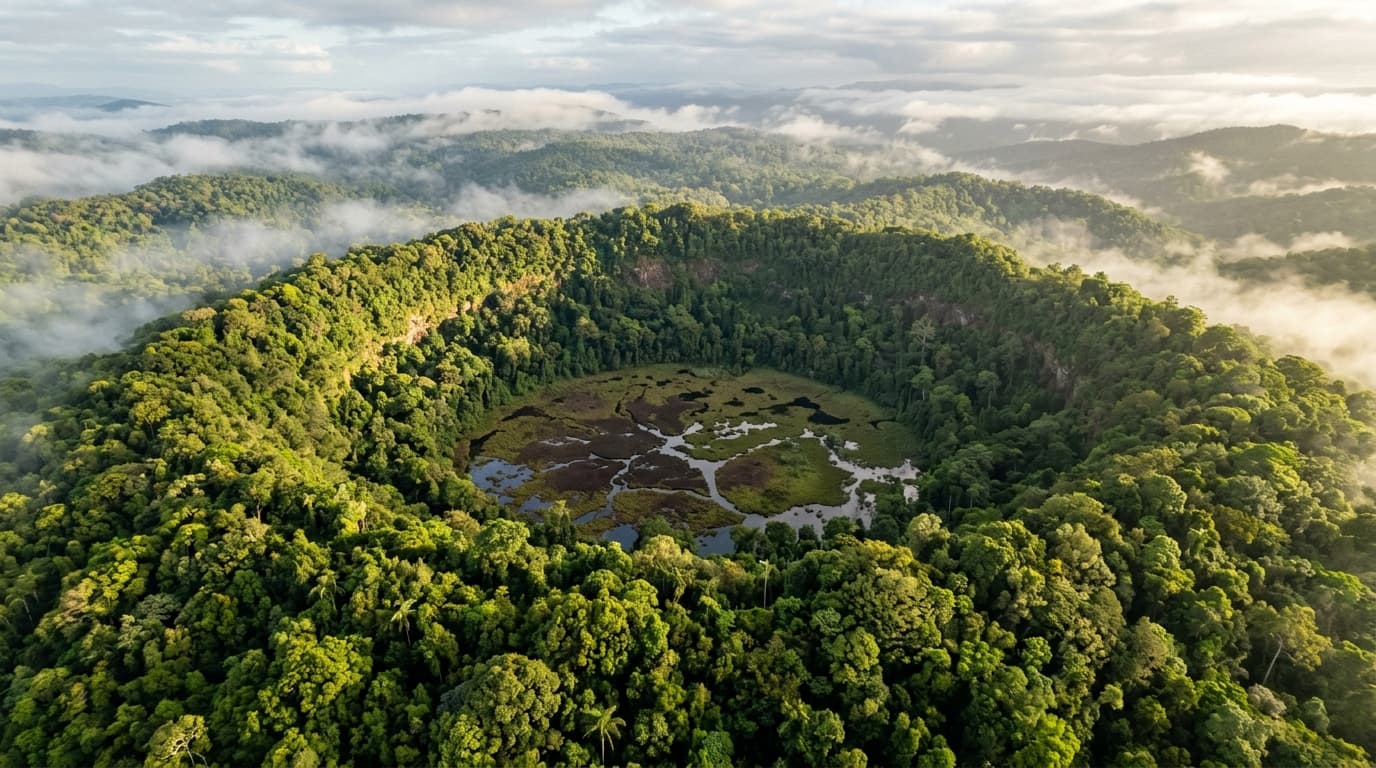
The Black Stuff is extracted from the Krakatoa deposit at Lynch's Crater on the Atherton Tablelands in Far North Queensland. This deposit underpins the brand's natural integrity, provenance, and long-term commercial differentiation.
The origin
A volcanic crater. 230,000 years. Anaerobic peat formation.
Lynch's Crater sits on the Atherton Tablelands in Far North Queensland. It formed approximately 230,000 years ago when rising magma met groundwater, producing a phreatomagmatic explosion that created a maar — a broad, shallow volcanic crater.
The crater filled with water over millennia. Organic material settled on the lake bed under anaerobic conditions. Without oxygen, decomposition stalled. Peat accumulated. The deposit built up slowly across geological timescales.
The result is a concentrated deposit of volcanic peat containing humic acid, fulvic acid, and organic matter — formed through natural geological processes, not chemical extraction. That is the starting material for The Black Stuff.
230,000
years of formation
Lynch's Crater, Atherton Tablelands
Far North Queensland
Distinguishing characteristics
What separates this material.
Not all humate sources are equivalent. Source geology, formation conditions, and processing method determine what ends up in the root zone. Here is how Lynch's Crater compares.
Volcanic Peat, Not Brown Coal
Formed from organic matter deposited under volcanic crater lake conditions. This is natural peat — not mined leonardite or brown coal that requires chemical processing to isolate active compounds.
No Chemical Extraction
Most commercial humate products use potassium hydroxide (KOH) to extract humic acids from leonardite. The Black Stuff requires no chemical processing. The active compounds are already present in the source material.
Domestic Origin
Sourced entirely from North Queensland. Domestic origin provides supply continuity and full traceability. No international shipping dependencies.
A Scarce Domestic Resource
Australia has few major humate reserves. Lynch's Crater represents a concentrated, high-quality alternative to imports and the limited domestic leonardite sources currently available.
Anaerobic Formation
Oxygen-free lake conditions preserved organic compounds over geological time. Evidence suggests this produces a more concentrated humic substance profile than aerobic deposits of comparable age.
Full Humic Spectrum
Contains both humic acid (higher molecular weight, soil-resident) and fulvic acid (lower molecular weight, plant-available) alongside organic matter. Designed to help support both nutrient retention and root-zone performance.
Why origin matters commercially
Why origin matters commercially
The Black Stuff is built on geological scarcity, Southern Hemisphere provenance, zero chemical processing, APAC supply relevance, and a product identity that is hard to replicate with processed alternatives.
- 91% of Australia's fertiliser is imported — domestic alternatives offer supply continuity and traceability
- Domestic urea production sits at approximately 15% of national consumption
- Domestic humate reserves remain under-utilised relative to import volumes
- Domestic availability removes exposure to international freight costs, tariffs, and geopolitical disruption
- Southern Hemisphere provenance and natural formation provide product differentiation that processed alternatives cannot replicate
The Lynch's Crater source sits within a fully domestic supply chain. That does not make it better than every alternative. It does make it more reliable to access.
Australia's fertiliser import exposure
Source: Australian fertiliser industry data, 2024.
Resource versatility
One source material. Multiple applications.
The Lynch's Crater deposit supports agricultural soil conditioning and derivative product applications. This page covers the agricultural use. The resource supports a broader range of products from the same humate material.
Same source. Same supply chain. Different formats for different needs.
Next step