Trials & Results
Data first. Claims second.
The Black Stuff competes on verified analysis, field observations, and independent trial work. We would rather show the data than oversell the story.
Published Research
What the peer-reviewed evidence suggests
A 2024 meta-analysis by Ma et al., published in Agronomy, synthesised findings from humic substance trials conducted worldwide. The figures below are averages observed across multiple studies, crops, and soil types.
+12%
Average Crop Yield Increase
Observed across diverse crop types and growing conditions in the meta-analysis. Individual results varied by soil and climate.
+27%
Nitrogen Use Efficiency
More crop output per unit of nitrogen applied. When growers are looking for better efficiency from expensive inputs, this is the number that matters most.
+17%
Nitrogen Uptake
Measured improvement in plant absorption of available nitrogen, supporting stronger root-zone performance and output.
Important context: These are averages from a global meta-analysis. Benefits were most pronounced in soils with lower existing organic matter and moderate pH. Effects may be reduced in highly alkaline soils or soils already high in nitrogen. Your results will depend on your soil, climate, and management. Source: Ma et al. (2024), Agronomy.
Australian Field Trial
First Australian TR1 trial — 4+ years and counting
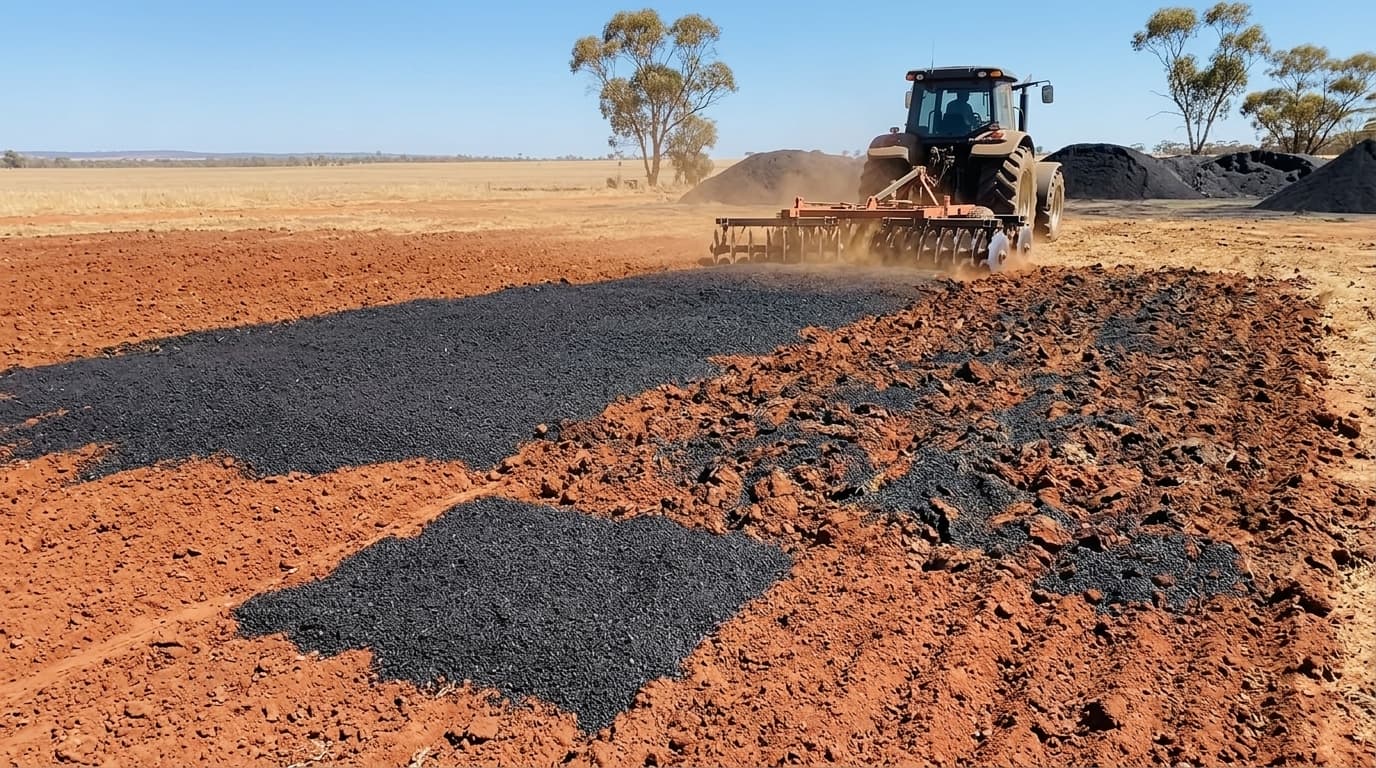
The East Palmerston trial is the first documented Australian field trial of TBS on confirmed TR1-affected soil. It remains ongoing with zero reapplication since 2021.
East Palmerston TR1 Plantain Trial
East Palmerston, QLD, Australia · 2021 – ongoing (4+ years)
First Australian field trial on confirmed TR1-affected soil. TBS-treated rows remain completely TR1-free after 4+ years with no additional TBS applied since January 2021. Syngenta TR product used as control comparison. TBS improves soil and plant health, increasing resistance to TR1 pathogens.
- Confirmed TR1 'dirty' soil — verified pathogen presence
- TBS applied once (Jan 2021) — zero reapplication since
- Treated rows: zero TR1 symptoms after 4+ years
- Control comparison with Syngenta TR product
Ongoing field trial. TBS is not a registered pesticide. It supports pathogen resistance through improved soil and plant health, not direct pathogen control.
Field Trials
Supervised trial data across crops and conditions
Trial data from Australian and international field conditions. All trials supervised by government agricultural departments. Full trial reports available on request.
TR1 Sugar Banana Trial
Results availableLocation
Lao PDR
Crop
Sugar Bananas
Period
2019 – 2020 (9 months)
Focus Area
TR1 pathogen resistance, plant growth
Observed Outcome
9-month trial on a verified TR1-affected 50-hectare site. At 3T/ha application rate, TBS-treated plants reached 187cm height and 50cm circumference. All control plants were dead by month 9. Supervised by the Plant Protection Center, Lao PDR.
- TBS at 3T/ha: 187cm height, 50cm circumference at 9 months
- ALL control plants dead by month 9
- Verified TR1-affected 50-hectare trial site
- Supervised by Plant Protection Center, Lao PDR
TBS is not a registered pesticide. It supports resistance through improved soil and plant health, not direct pathogen control.
Full trial report available on request
TR4 Cavendish Banana Trial
Results availableLocation
Vang Vieng, Lao PDR
Crop
Cavendish Bananas
Period
2019 – 2020
Focus Area
TR4 pathogen resistance
Observed Outcome
Trial conducted on a verified TR4-affected abandoned farm (2.4ha trial area). ANOVA with Duncan's test applied. Supervised by the Department of Agriculture, Lao PDR. Trial curtailed by COVID-19 restrictions but preliminary data collected.
- Verified TR4-affected abandoned commercial farm
- 2.4ha trial area with statistical design (ANOVA, Duncan's test)
- Department of Agriculture supervised
- COVID-19 curtailed full trial completion
Trial experienced protocol execution challenges and was curtailed by COVID-19. TBS is not a registered pesticide. It supports resistance through improved soil and plant health.
Full trial report available on request
Wet Season Rice Trial (3-Year)
Results availableLocation
Lao PDR
Crop
Rice
Period
2019 – 2021
Focus Area
Yield improvement, fertiliser efficiency, persistency
Observed Outcome
Three-year trial demonstrating yield increases of +45%, +56%, and +69% across three TBS application rates. In the 2021 follow-up — with zero additional TBS input — yields remained approximately 50% above baseline. Grade A grain quality achieved. Witnessed by the Lao PDR Department of Agriculture.
- Year 1: +45%, +56%, +69% yield increase across 3 rates
- Year 3 (no reapplication): yields still ~50% above baseline
- Grade A grain quality maintained throughout
- Witnessed by Lao PDR Department of Agriculture
Full trial report available on request
Dry Season Rice Trial
Results availableLocation
Lao PDR
Crop
Rice
Period
2020
Focus Area
Drought resilience, yield without fertiliser
Observed Outcome
During a 50% drought year, TBS-only plots (no fertiliser applied) yielded +30% above baseline. Control plots using standard NPK fertiliser yielded -20% below baseline. Sandy loam soil at pH 4.4. Demonstrates TBS performance under extreme stress conditions without any fertiliser.
- TBS-only (zero fertiliser): +30% above baseline
- Standard NPK control: -20% below baseline
- 50% drought conditions during trial period
- Sandy loam, pH 4.4 — challenging soil conditions
Full trial report available on request
Government Corn & Banana Trial
Results availableLocation
Lao PDR
Crop
Corn and Bananas
Period
2019 – 2020
Focus Area
Growth rate, statistical validation
Observed Outcome
Government trial conducted by the Plant Protection Centre and Department of Agriculture, Lao PDR. Completely Randomised Design with ANOVA (P<0.05). At 3T/ha: banana leaves 10.00 at 90 days (vs 5.50 control), height 105.25cm (vs 45.00 control). Corn height at 60 days: 134.25cm (vs 20.50 control). All results statistically significant.
- Banana at 3T/ha: 10.00 leaves at 90 days (control: 5.50)
- Banana height: 105.25cm vs 45.00cm control (+134%)
- Corn height at 60 days: 134.25cm vs 20.50cm (+555%)
- ANOVA P<0.05 — statistically significant results
Full trial report available on request
Technical Resources
Documentation for the detail-minded
Technical documentation for agronomists, consultants, and growers who want to see what is behind the product before making a recommendation.
Product Technical Analysis
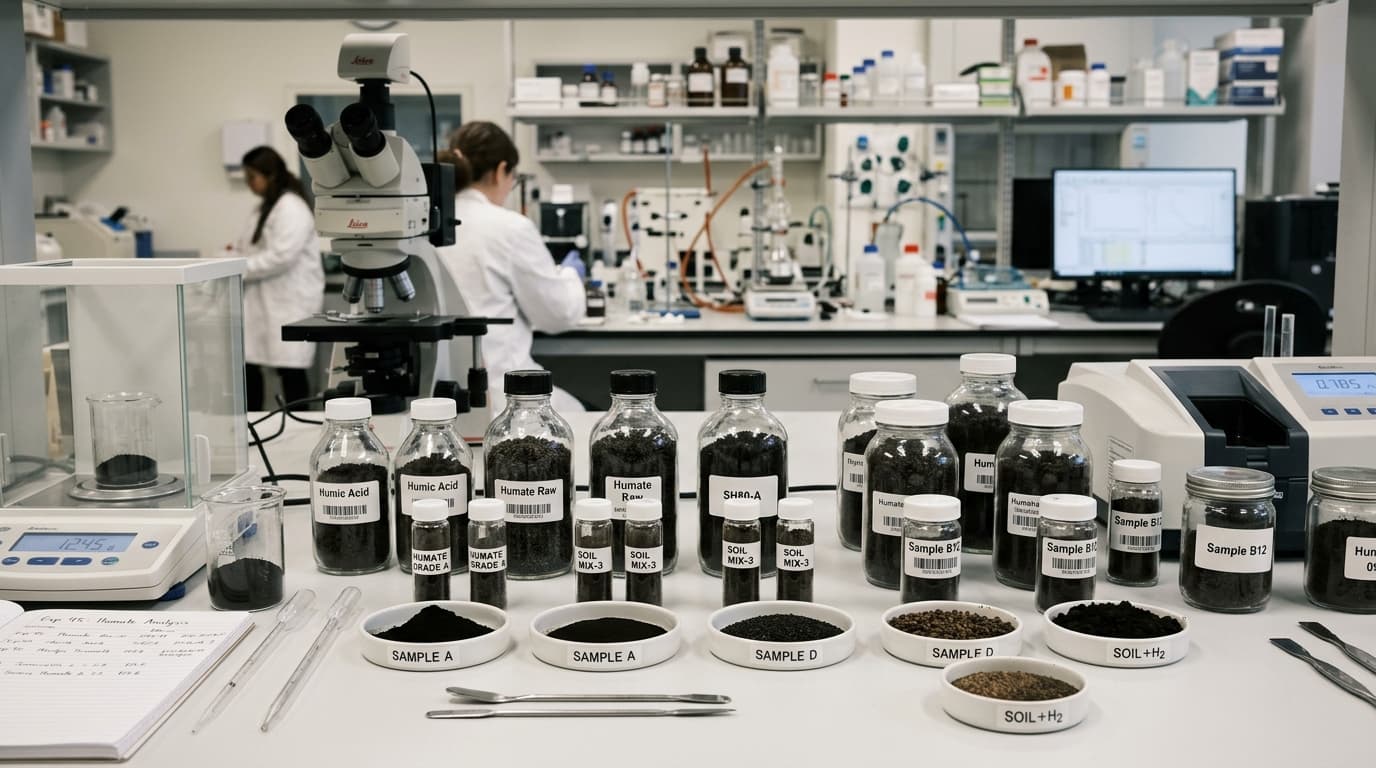
Composition breakdown including humic and fulvic acid concentrations, mineral profile, and laboratory analysis of The Black Stuff.
View DocumentApplication Guidelines
Recommended rates, timing, and methods by crop type and soil condition. Rates may vary — discuss with your agronomist.
Available on request
Composition Data
Full laboratory analysis covering humate composition, trace elements, pH, and organic matter content.
Available on request
A note on these results: All data presented on this page comes from specific trial sites, published research, or qualified field observations. Outcomes vary by soil type, climate, existing organic matter, and management practices. The Black Stuff is a soil conditioner. It is not a registered pesticide or fertiliser. We present what was measured. Your conditions will differ.
Want the technical material or trial documents?
Request specific trial reports, laboratory analysis, or crop-specific technical documentation. We share everything we have with growers and advisers who are evaluating fit.