
How it works
Five mechanisms that help expensive fertiliser go further.
The Black Stuff contains the full spectrum of humic substances — humic acid, fulvic acid, and humin. Here is how each mechanism is designed to support fertiliser efficiency, soil performance, and long-term farm benefit.
At a glance
Five ways it supports your program.
The Black Stuff contains the full spectrum of humic substances — humic acid, fulvic acid, and humin. That spectrum is what delivers all five mechanisms from a single product.
Nutrient Retention (CEC)
Designed to bind positively-charged nutrients in the root zone. Supports retention of nitrogen, potassium, calcium, and magnesium.
Moisture Holding
Designed to hold up to 20x its weight in moisture. Supports crops through dry periods and reduces irrigation demand.
Reduced Leaching and Runoff
Designed to help keep nitrogen and phosphorus in the field. Supports reef compliance and reduces input waste.
Root-Zone Biology
Supports microbial activity. Fulvic acid chelates minerals and is designed to help transport them through cell walls.
Soil Structure
Supports soil aggregation for better aeration, water infiltration, and root-zone performance.
Program Fit
Not a replacement for fertiliser. Designed to improve input efficiency alongside your existing synthetic or organic program.
Where the money is
Nutrient Retention (Cation Exchange Capacity)
When fertiliser inputs are expensive, every kilogram of nitrogen that leaches past the root zone is money lost. Humic substances have a very high cation exchange capacity (CEC) — they bind and hold positively-charged nutrient ions like ammonium-nitrogen, potassium, calcium, and magnesium. Instead of washing through the soil profile after rain or irrigation, those nutrients stay in the root zone where the crop can actually use them.
In the right conditions, field and trial evidence suggests that improved nutrient retention can reduce synthetic fertiliser requirement by up to 30%. Better retention supports a stronger return on every application. CEC is the single most commercially relevant mechanism humic substances offer.

CEC is the primary commercial mechanism. It is designed to help you get more from the fertiliser you already apply.
Less water out. More water available.
Moisture Holding
The Black Stuff is designed to hold up to 20 times its weight in moisture. In the root zone, that additional moisture holding capacity supports crops between watering events and reduces irrigation frequency. Less water pumped. Lower costs. More consistent growing conditions.
This matters most where rainfall is unreliable or irrigation is a significant cost line. In North Queensland, tropical wet-dry cycles swing between waterlogging and drought stress. Better moisture holding in the root zone helps buffer both extremes.
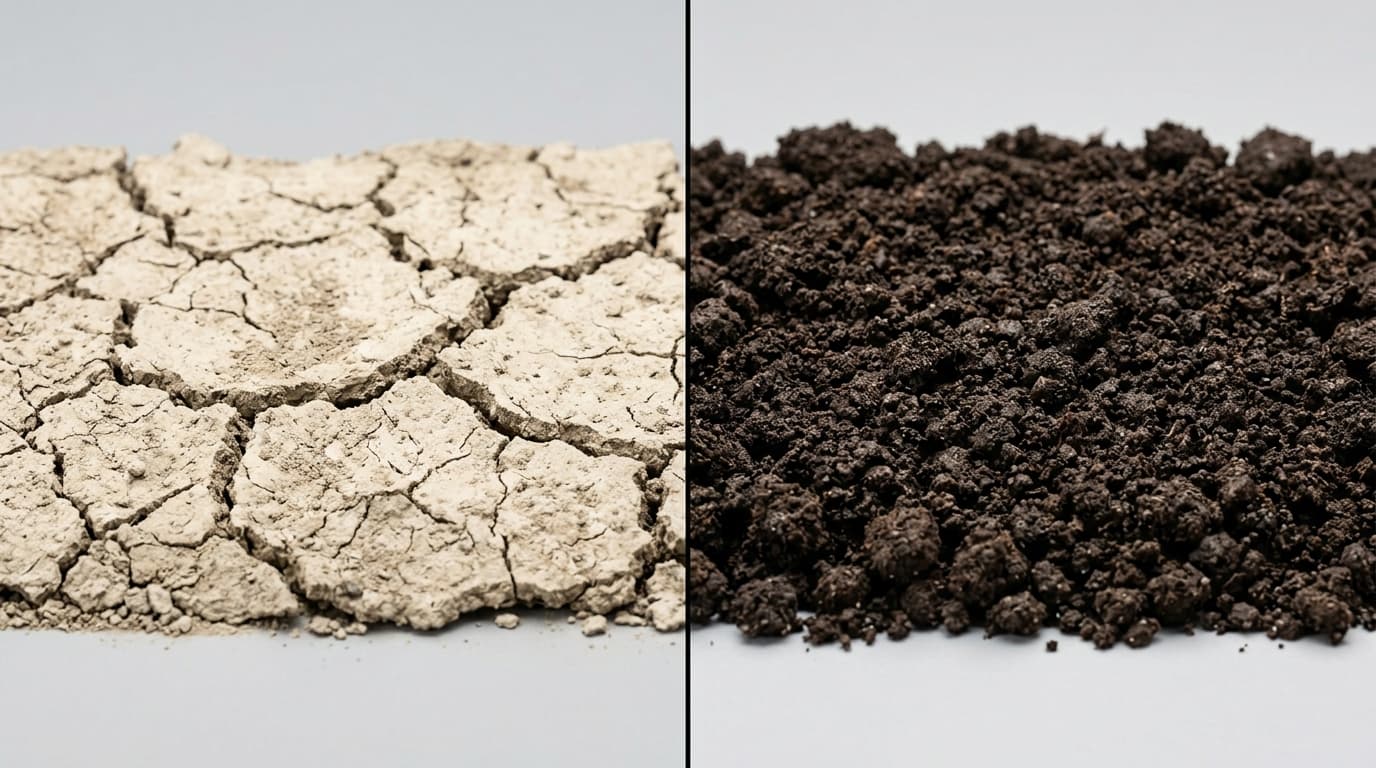
Designed to hold up to 20x its weight in moisture. Supports reduced irrigation demand.
Keep inputs in the field
Reduced Leaching and Runoff
When nutrient inputs are expensive, nitrogen and phosphorus that leaves the field through leaching or runoff is money that does not come back. By holding nitrogen and phosphorus in the root zone through CEC, The Black Stuff is designed to help reduce what leaches through the profile or runs off the surface during rainfall. Better retention means better input efficiency.
In Queensland, reef water quality regulations require growers to demonstrate responsible nutrient management. Reduced nutrient loss from the field supports both compliance and cost control. One mechanism, two outcomes.

Supports nutrient retention in the field and helps growers manage reef water quality requirements.
Feeding the biology that feeds the crop
Root-Zone Biology
Humic and fulvic acids support beneficial microbial activity in the root zone. Fulvic acid — the smallest molecular fraction — chelates mineral nutrients and is designed to help transport them through cell walls into plant tissue. This supports nutrient availability even when soil conditions would otherwise lock nutrients out.
In the root zone, fulvic acid supports nutrient availability even when soil conditions would otherwise lock nutrients out. This is particularly relevant in problem soils or during stress periods.

Fulvic acid chelates minerals and supports transport through cell walls in the root zone.
Better structure compounds over time
Soil Structure Improvement
Humic substances bind soil particles into stable aggregates. More aggregation means more pore space for air and water, less compaction, and better conditions for root development. Improved structure also supports water infiltration rather than surface runoff.
This is a long-game benefit. Over successive applications, improved soil structure supports stronger root systems, more established microbial communities, and greater resilience to wet and dry extremes. Each season builds on the last.

Supports soil aggregation, aeration, and root-zone performance. Benefits designed to compound over time.
Persistency
Persistency — a key advantage of granular TBS
One of the key benefits of granular TBS is that it is persistent. It does not degrade in the soil. Applied correctly, it continues to improve nutrient retention and soil performance across multiple seasons.
Note: Surface applications of TBS can dry out and blow away or be washed away. Soil incorporation is recommended where possible. TBS has a low pH and depending on soils may need some lime balancing.
Program fit
It works with what you already use.
The Black Stuff is not a fertiliser replacement. It is designed to improve input efficiency alongside your existing program — synthetic, organic, or blended. Your program provides the nutrients. The Black Stuff is designed to help keep them in the root zone where they can do their job.
Think of it as a retention layer. Same inputs. Better utilisation. Lower cost per unit of nutrient that actually reaches the crop.
- Designed to work alongside standard urea, MAP, or blended fertiliser programs
- Suits both broadacre and intensive horticultural systems
- Available as dry granular soil amendment — solid form only
- Does not alter soil pH or interfere with existing input chemistry
- Supports precision placement strategies as recommended by your agronomist
Where it fits in your season
Apply to the soil before planting or ratoon. Designed to build CEC and moisture holding capacity in the root zone ahead of the crop.
Apply alongside nitrogen side-dressing. Designed to help retain ammonium-N in the root zone and reduce leaching after rain events.
Continued use supports soil organic matter and CEC over time. Evidence suggests benefits compound across seasons.
Field results
What the published data says.
These figures come from Ma et al. (2024), a meta-analysis published in Agronomy covering humic acid field results across global crop studies. They represent averages — individual results vary by soil type, crop, climate, and application method.
More crop output per unit of nitrogen applied. When growers invest in premium inputs, this efficiency gain is the core commercial justification.
More nitrogen entering the plant, in trials. Evidence suggests improved availability in the root zone and better biological transport.
Yield improvement across a range of crops and conditions, in trials. The downstream result of better nutrient retention and uptake.
Source: Ma et al. (2024). "Comprehensive Meta-Analysis on the Effects of Humic Acids on Crops." Agronomy 14(12), 2763. Results are study averages and may not reflect individual field outcomes.
Next steps
Want to assess whether The Black Stuff fits your program?
Whether you want to review trial data, discuss crop-specific application, or work out how The Black Stuff fits your existing fertiliser program — we are here to help.